
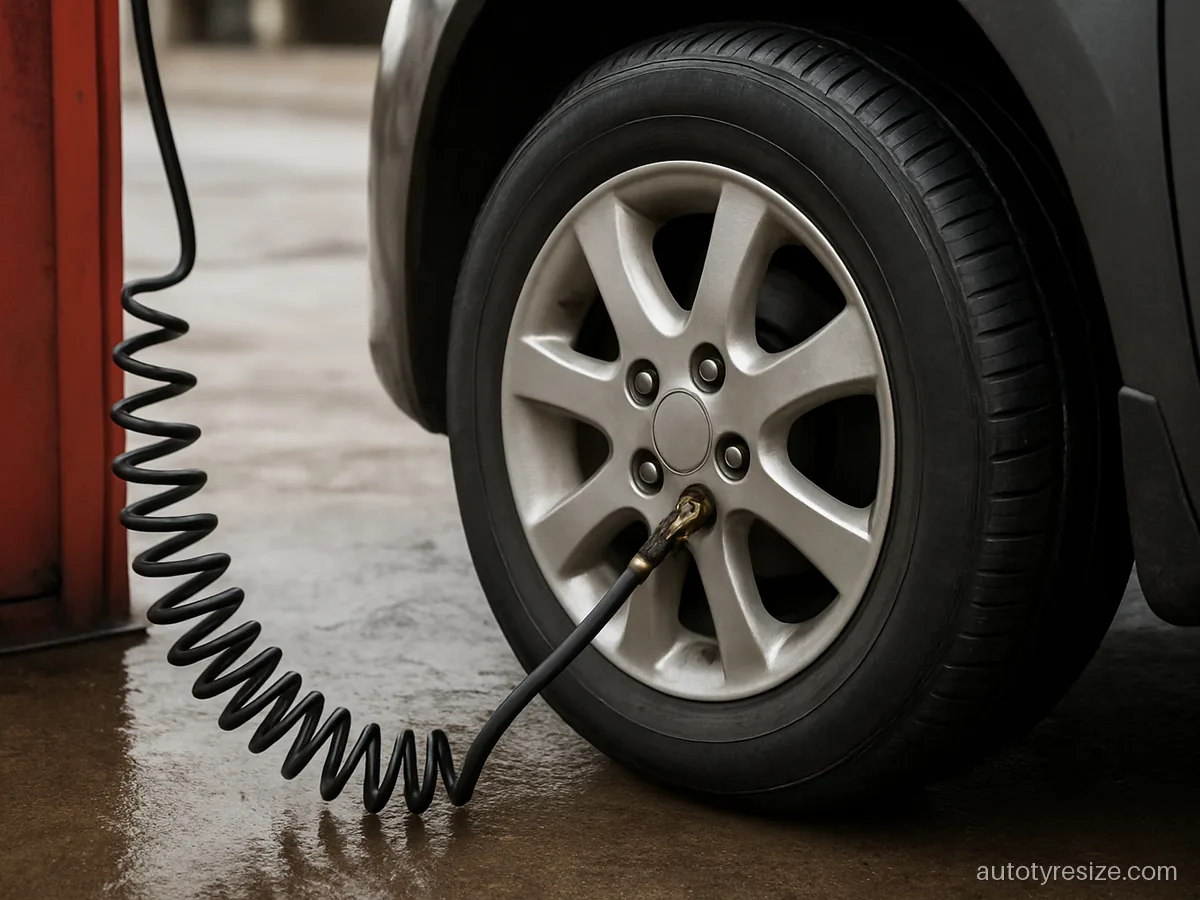
The right tyre pressure is the cold figure your vehicle maker prints on the door pillar label of a car, or in the handbook of a bike or scooter, never the maximum moulded on the tyre itself. For most cars that lands roughly between 29 and 36 psi, and for commuter two wheelers it sits lower at the front than at the rear.
This is the starting point for every pressure question on AutoTyreSize. Below you will find how pressure works, how to set it on the forecourt, and links to every model page and guide we have, so you can jump straight to your car, motorcycle or scooter.
At a glance
- Most carsAbout 29 to 36 psi cold; exact figure on the driver door sticker
- Commuter bikesAbout 25 to 28 psi front, 30 to 33 psi rear, rider only
- Many scooters22 psi front, 29 psi rear solo, rear raised for a pillion
- CyclesUse the range printed on the tyre: road tyres far higher than MTB
- Measure whenCold: parked about 3 hours or driven under 1.6 km
- Units1 bar = 100 kPa = 14.5 psi
- Check how oftenCars every two weeks, two wheelers weekly
Where your tyre pressure figure comes from
Vehicle makers choose the pressure after testing a car or bike at its weight, with its suspension and its factory tyre size. That number balances grip, braking, ride comfort, tyre life and fuel use. On cars it is printed on a placard on the driver door frame, and sometimes on the fuel flap or glovebox lid. On motorcycles and scooters it is in the owner's manual, usually in the maintenance or specifications chapter.
The number cast into the sidewall rubber means something else. It is the most air that tyre can hold at its full rated load, and it applies to that tyre on any vehicle. It is a ceiling, not a target. A huge share of the badly worn tyres I see came from owners who filled to that sidewall number thinking it was the recommendation.
Why there is no single tyre pressure chart by size
People often look for a tyre pressure chart by size, hoping that one tyre size always takes one figure. It does not work that way. The same tyre size can be fitted to a light hatchback and a heavier compact SUV, and each needs a different pressure because each puts a different load on the tyre. That is why a door sticker lists pressure for that vehicle, not for a size.
What a chart can do is show the usual range by vehicle type, which helps you spot a wrong number at the pump. Our car tyre pressure, bike tyre pressure and scooty tyre pressure pages each carry a typical tyre pressure chart for that type. For the exact figure, open your model page below.
Typical cold tyre pressure ranges
| Vehicle | Front | Rear | Where the exact figure is |
|---|---|---|---|
| Passenger car | About 29 to 36 psi; some cars differ front and rear | Driver door sticker, owner's manual | |
| Commuter motorcycle, solo | About 25 to 28 psi | About 30 to 33 psi | Owner's manual |
| Commuter motorcycle, two-up | Usually unchanged | About 33 to 36 psi | Owner's manual |
| Scooter, solo | Often 22 psi | Often 29 psi | Owner's manual |
| Scooter, two-up | Often 22 psi | Often about 36 psi | Owner's manual |
| Road cycle | About 80 to 130 psi | Tyre sidewall range | |
| Mountain bike | About 25 to 50 psi | Tyre sidewall range | |
These ranges help you spot a mistake. They are not a replacement for your own vehicle's figure.
Hot, cold and the Indian summer
Every figure a maker gives is a cold figure. Cold means the vehicle has stood for about three hours, or has moved less than 1.6 km. Once you drive, the tyre flexes and heats up, and the air inside expands. Carmakers' manuals note a warm tyre can read roughly 4 to 6 psi above its cold value. The weather adds to this. Pressure moves about 1 psi for every 5.6 °C change in temperature, so a tyre set at dawn reads higher by the afternoon.
The practical rule: never let air out of a hot tyre to match the cold number. If you fill after a drive, aim a couple of psi above the sticker and recheck the next morning. Our guide on how to check tyre pressure covers the whole routine.
What wrong tyre pressure does on Indian roads
Under-inflation is the more common fault and the more dangerous one. The sidewall flexes more, which builds heat. The tread wears on both shoulders, steering turns heavy, and rolling resistance goes up, so fuel use creeps up too. Drop a soft tyre into a pothole and it gets pinched or cut far more easily, and on a long, hot expressway run it is the tyre most at risk of failure.
Over-inflation makes the tread crown, so the centre wears first and the contact patch shrinks. Braking distances grow on wet roads, the ride turns harsh over speed breakers, and the steering can feel skittish. A small amount over the sticker figure is not harmful, but filling to the sidewall maximum is never right.
Setting tyre pressure at the petrol pump
Most of us fill at the pump. A few habits make it reliable:
- Know your front and rear figures, and the loaded figure if you are carrying people or luggage.
- Check the unit on the machine. If your sticker is in kPa or bar, convert first with the pressure converter.
- Ask for each axle separately. "Same all round" is wrong for most two wheelers and for many cars.
- Confirm with your own tyre pressure gauge afterwards. Pump gauges vary.
- Put the valve caps back.
Read about the air filling machine and whether nitrogen in tyres is worth it if your pump offers it.
Loads, trips and the spare wheel
Weight changes what a tyre needs. A car with five adults and a boot full of bags for a hill station drive presses each tyre much harder than the same car on a solo office run. That is why many door stickers carry a second, higher figure for full load, usually at the rear. Switch to it before the trip and back afterwards. On two wheelers, the pillion figure does the same job.
The spare is the tyre everyone forgets. It sits for months in the boot well losing a little air, and is often found flat on the one night it is needed. Check it whenever you check the others. A space saver spare usually needs a much higher figure than the road tyres, so read the manual for it.
Car tyre pressure pages by model
Each page gives the checked cold figure front and rear, the full load figure where the maker publishes one, and notes for that car's tyre sizes.
Motorcycle and scooter tyre pressure pages
| Access 125 | Activa | Activa 125 |
| Aerox 155 | Burgman Street | Dio |
| Fascino 125 | iQube | Jupiter |
| Jupiter 125 | Ntorq 125 | Ntorq 150 |
| RayZR 125 | Scooty Pep Plus | Wego |
| Zest |
Two wheeler pages list rider only and pillion figures separately, since the rear changes a lot with a passenger.
Tyre pressure guides and tools
| Guide | What it covers |
|---|---|
| Pressure unit converter | Pressure unit converter: kPa, bar, kgf/cm² and psi |
| How to check pressure | How to check tyre pressure, step by step |
| TPMS | TPMS: how pressure monitors and sensors work |
| Car tyre pressure | Car tyre pressure: usual range, front and rear |
| Bike tyre pressure | Bike tyre pressure: front, rear and pillion |
| Scooty tyre pressure | Scooty tyre pressure: front, back and two-up |
| Cycle tyre pressure | Cycle tyre pressure by cycle type |
| Tyre pressure gauge | Tyre pressure gauge types and use |
| Pressure warning light | Tyre pressure warning light and reset |
| Nitrogen in tyres | Nitrogen or normal air in tyres |
| Air filling machine | Petrol pump air filling machine |
| Tractor tyre pressure | Tractor tyre pressure |
Also see the TPMS guide if your car warns you about pressure, and the warning light page for what each light pattern means.
Models not yet on this site
| Model readers ask about | Where to find the tyre pressure |
|---|---|
| Bear 650 | Owner's manual, tyre section |
| Z900 | Owner's manual, tyre section |
| HF Deluxe | Owner's manual, tyre section |
| Ritz | Driver door sticker and owner's manual |
| Taigun | Driver door sticker and owner's manual |
| XEV 9E | Driver door sticker and owner's manual |
| Jimny | Driver door sticker and owner's manual |
| Etios Liva | Driver door sticker and owner's manual |
For any vehicle not listed above, the same rule applies: use the cold figure from the door sticker for cars or the owner's manual for two wheelers. If you have a used vehicle with no manual, the maker's service centre can give you the figure from the vehicle number.
Questions owners ask
What is the correct tyre pressure for my vehicle?
The cold figure from your vehicle maker: the door pillar label for a car, or the handbook for a two wheeler. Pick your model from the tables on this page to see it.
Is the pressure written on the tyre the one to fill?
No. That moulded number is a ceiling tied to the tyre's full load rating. Filling to it gives a harsh ride, less grip and faster centre wear.
How often should I check tyre pressure?
Every two weeks for cars and every week for two wheelers, plus before any long trip. Always check cold for an accurate reading.
Should front and rear tyre pressure be the same?
On many cars they are the same for normal load. On most bikes and scooters the rear is higher. Always fill each axle to its own figure.
Does tyre pressure change with weather?
Yes, by about 1 psi for every 5.6 °C change. That is why you should check in the morning before driving and use the same cold figure all year.
What is the difference between psi, bar and kPa?
They are units for the same thing. One bar is 100 kPa, which is about 14.5 psi. Use the converter if your sticker and pump use different units.