
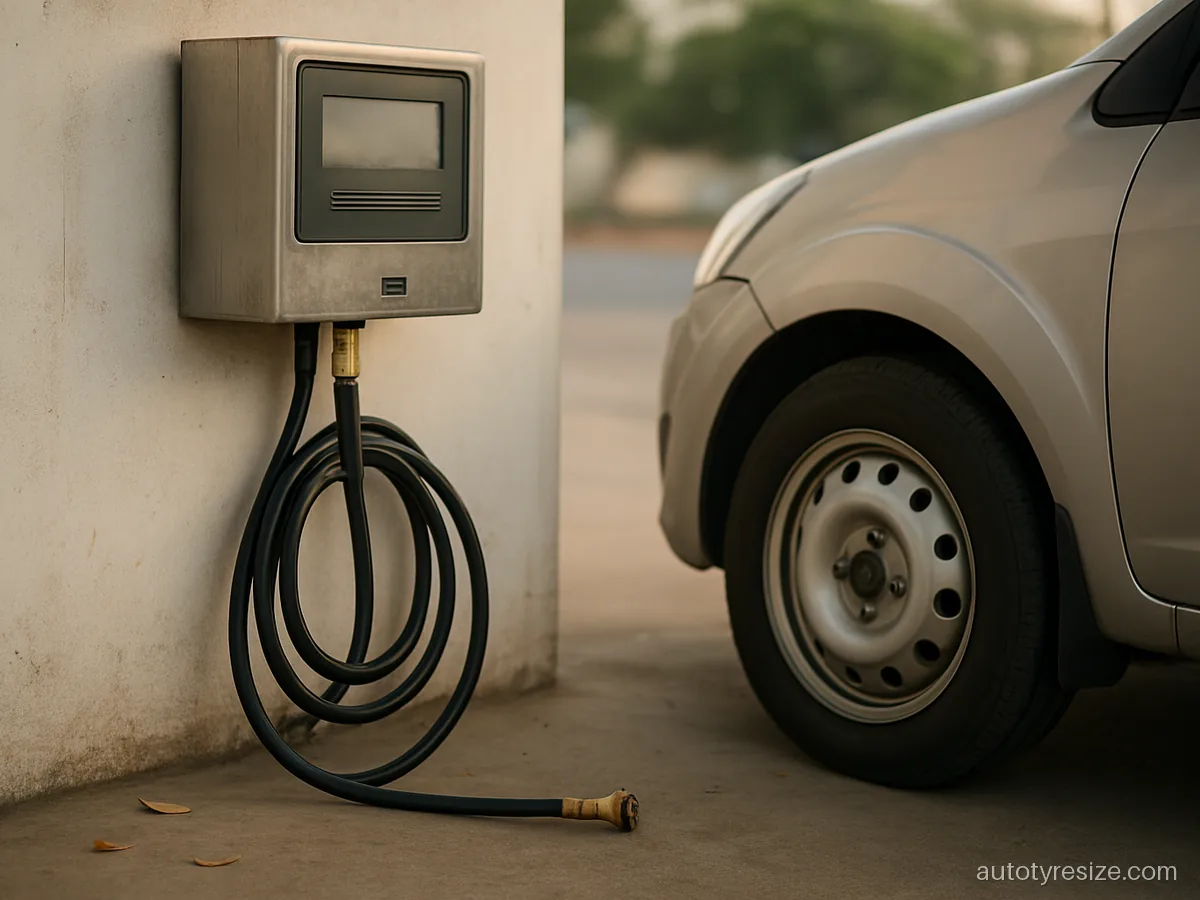
A tyre pressure machine is the air unit at a fuel station or tyre shop that fills and reads your tyres, and the right way to use it is to set the cold figure from your door sticker or owner's manual, fill each tyre, then confirm one tyre with your own gauge. The machine is a tool. The number you key in is what decides how the vehicle rides and brakes.
In our shop the compressor runs all day, and I still see owners walk up, punch in a random number and drive off. This guide explains the kinds of air machine you will meet in India, how each one behaves, and the small habits that get you a correct reading every time.
At a glance
- Common typesDigital preset unit, dial hose unit, nitrogen unit, portable inflator
- What to setThe cold figure from the door sticker or owner's manual
- Never setThe maximum number moulded on the tyre sidewall
- Best time to use itBefore a long ride, at the nearest station to home
- Flat tyrePreset units may not start on a fully flat tyre; ask the attendant
- Cross-checkRead one tyre with your own gauge after filling
Kinds of tyre air pressure machine you will see
| Type | Where you find it | How it works |
|---|---|---|
| Digital preset unit | Most fuel stations in towns and cities | You set a psi number with plus and minus keys, fit the chuck, and it fills or bleeds until it reaches that number, then beeps |
| Dial hose unit | Older stations, village pumps, roadside puncture shops | An attendant holds the chuck and watches a needle gauge, filling in bursts |
| Nitrogen unit | Some stations and tyre shops, usually a separate counter | Same idea, but filled from a nitrogen generator instead of plain compressed air |
| Portable inflator | Your boot or under the seat | Runs from the 12 volt socket or its own battery, with a built-in gauge and often an auto stop |
All of them push air in. None of them knows what your vehicle needs. That figure comes from you. For more on the plug-in types, see the tyre inflator guide.
Using a digital tyre pressure machine step by step
- Stop the vehicle where the hose can reach every wheel without being dragged over a tyre.
- Look up your cold figure first. Car makers print it on a small panel glued inside the frame of the right front door; two wheelers list it in the owner's manual, sometimes repeated on a decal near the rear wheel.
- Set the number on the display. If front and rear differ, set the front value first and do both front tyres.
- Remove the valve cap and drop it in a shirt pocket so it cannot vanish under the vehicle.
- Press the chuck straight on until the hissing stops. A slanted push leaks and gives a false reading.
- Wait for the beep or the finished signal, then pull the chuck off in one quick move.
- Change the setting for the rear and repeat. Do the spare on a car when you can.
- Refit every cap.
Why the result can still be off
These units take a beating. Hoses get run over, chucks get dropped, and the sensor inside drifts with heat and dust. A machine that sits in the afternoon sun at a highway station can read a little different from one in a shaded city forecourt. That is why owning a pocket gauge is cheap insurance. Fill with the machine, then test any single wheel with it. If the two agree within a psi or so, trust the fill. If they disagree, top up or bleed with your gauge as the judge.
Warm tyres also read higher. If you have just ridden twenty minutes on a hot road, the reading at the pump will be above the cold figure even when the tyre is right. Bleeding a just-driven tyre until it shows the cold number means it ends up underfilled by the next morning. Fill at the station closest to home, or top up slightly above the sticker value and confirm after the vehicle has stood overnight.
Tyre pressure check machine on a flat or very low tyre
Many preset units need a little pressure already in the tyre to sense that a valve is connected. On a fully flat tyre they may not start. Ask the attendant to switch to manual fill, or use a dial hose for the first few psi. More important: a tyre that has gone flat overnight has a leak. Fill it to get moving, then go straight to a shop for a check. Read the tyre puncture guide if it keeps losing air. If the car or bike was driven any distance while flat, ask the shop to look at the inner sidewall too, since running flat can damage it from the inside.
Free air and what you can ask for at a fuel station
The fuel companies' rules for their outlets list free air for tyres among the basic services a station must offer, along with drinking water and a toilet. If the air unit is out of order, the station's complaint register is the place to note it. Air is free at these outlets; nitrogen filling is usually a separate paid service, and plain air from a working machine is perfectly fine for normal road use. See nitrogen in tyres if you want the full comparison.
Tyre pressure pump at home versus the station machine
A foot pump or small electric pump at home has one big advantage: you can fill tyres that have stood overnight, so the reading is truly cold. A station machine has the advantage of speed and a higher flow, which helps on bigger SUV tyres. Many owners do both. They keep a small pump and gauge at home for the fortnightly top-up and use the station for a quick fill before a trip. A portable inflator also gets you out of trouble on a ghat road at night, far from any station.
Small habits that save tyres
- Check every two weeks and before any highway run. Tyres lose a little air even with no puncture.
- Before a full family trip, use the loaded figure if your manual gives one.
- In the monsoon, a slow leak hides well. If one tyre keeps needing air, have it checked at a shop.
- Swap any lost or split valve cap at once; grit that gets into the core lets air seep out.
- Do not let anyone fill to the sidewall maximum. That number is the limit of the tyre, not a target.
For the full picture on figures and why they differ by vehicle, start at the tyre pressure hub, and for a unit that only shows bar or kPa, our unit converter translates your psi.
Questions owners ask
What psi should I set on the tyre pressure machine?
Enter the cold psi given on the B pillar placard of a car, or the manual for a two wheeler. Front and rear may differ. The limit moulded on the tyre wall is not what you set.
Is the air at petrol pumps free?
At fuel company outlets, free tyre air is one of the basic services the station is expected to provide. Nitrogen filling, where offered, is often a separate paid service.
Why does the machine show a different reading from my gauge?
Forecourt units drift with use, and a tyre that has just been driven on gives a higher reading than one that has rested. Trust a gauge you keep in good condition and check on cold tyres when you can.
Can a tyre air pressure machine show bar instead of psi?
Yes, some units can switch units. Ask the attendant to change it to psi, or convert your figure before you set it.
The machine will not start on my flat tyre. What do I do?
Preset units often need some pressure in the tyre before they start. Ask for manual fill, then take the vehicle to a tyre shop because a flat tyre usually means a leak.
Should I fill to the same pressure in summer and winter?
The cold value stays the same through every season. What changes is that a sun-baked afternoon tyre shows more, so morning fills or a pump near home give truer results.