
The Wagon R tyre pressure should be 32 psi, measured cold, for the 155/80 R13 tyres of the LXi and 33 psi cold when the car wears 165/70 R14 tyres, as the three higher trims do. Front and back take the same figure.
Swing the driver door open: a printed label on the body pillar carries your car's figure, with the same number again in the manual. When it disagrees with a chart, including ours, the label wins. Whatever psi is moulded on the sidewall is just the tyre maker's upper limit, never a filling target.
Wagon R fitment card
- Tyre size
- 155/80 R13 (LXi, LXi CNG), 165/70 R14 (VXi, VXi CNG, ZXi, ZXi Plus)
- Wheels
- 13 inch steel on LXi, 14 inch steel on VXi and ZXi, 14 inch alloy on ZXi Plus
- Tyre pressure (cold)
- 32 psi front and rear on 13 inch tyres, 33 psi on 14 inch tyres
- PCD
- 4 x 100 mm, centre bore 54.1 mm
- Spare
- Steel spare wheel on every variant, including the ZXi Plus
- Wheel cap
- 13 inch (LXi), 14 inch (VXi and other 14 inch steel wheels)
- Battery
- 12 V, 35 Ah
- Earlier version tyres
- 145/80 R13 on lower variants, 155/65 R14 on upper variants
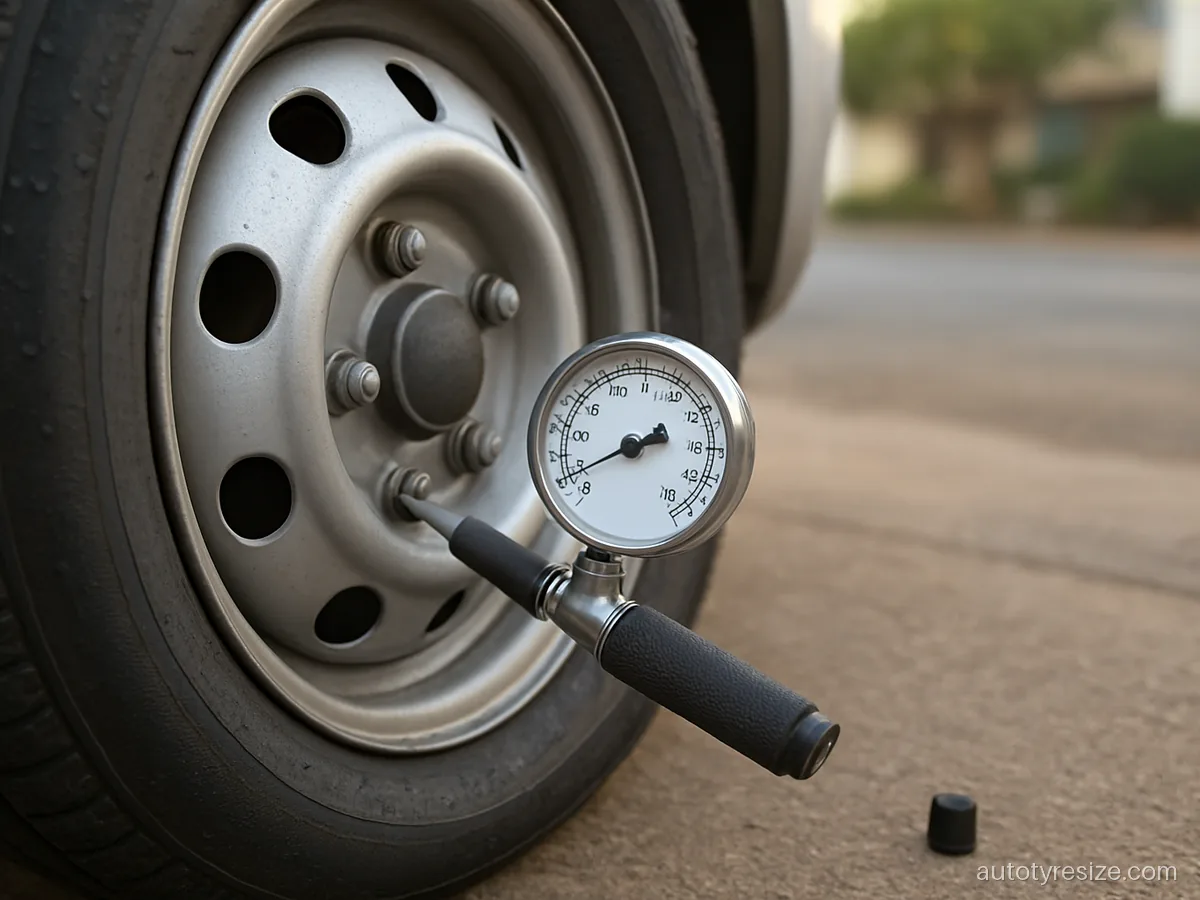
Wagon R tyre pressure chart
| Variant | Tyre | Front (cold) | Rear (cold) |
|---|---|---|---|
| LXi, LXi CNG | 155/80 R13 | 32 psi | 32 psi |
| VXi, VXi CNG | 165/70 R14 | 33 psi | 33 psi |
| ZXi, ZXi Plus | 165/70 R14 | 33 psi | 33 psi |
| Spare | Check sidewall | Fill as per door sticker | Fill as per door sticker |
Some tyre listings show a split, such as 36 psi at one end and 32 psi at the other, but they disagree on which end gets the higher figure. That is why the door sticker is the tie breaker. No source we checked gave a separate full load figure from the maker, so this chart leaves it blank.
What cold means at the pump
Take the reading after the Wagon R has been parked a few hours, or within roughly 2 km of setting off. A drive warms the trapped air and lifts the gauge reading by roughly 2 to 4 psi. Set 33 psi on hot tyres after a 20 minute run and you will find less than 33 the next morning.
When the pump is far from home, note the warm reading and set it roughly 3 psi higher than the cold target instead of bleeding air. Then check again next morning before you start.
Wagon R tyre air pressure in bar and kPa
Newer fuel station air units may display bar or kPa instead of psi. Converted, 32 psi is close to 2.2 bar (221 kPa); for 33 psi, set 2.3 bar (228 kPa). Any other figure can be turned around with the tyre pressure converter. Older machines with a dial in kg/cm² read almost the same as bar for this purpose.
Front and back, CNG and family trips
The Wagon R runs the same pressure front and back because its weight is fairly even and the tyres are small. A CNG car has its gas cylinder behind the rear seat, which loads up the back axle; keep them exactly on the sticker figure and check them more often. Never drop below it to soften the ride.
With five adults and luggage for a ghat road trip, look at the door sticker for a loaded value. If it gives none, stay on the normal figure but check all four tyres every fuel stop, since a small leak shows up fast under load.
Wrong air on a tall, light hatch
The Wagon R is tall and light. Under inflated tyres make it lean and wallow on lane changes, wear the outer shoulders, and cost mileage in stop and go traffic. They also flex and heat up on long expressway runs, which is how blowouts start.
Over inflated tyres make the ride harsh over speed breakers and scrub away the middle strip of tread first. On rain soaked lanes they also shrink the patch of rubber that grips, just when you need every bit of contact patch on a waterlogged lane. Stick to the sticker.
Checking pressure on your Wagon R
- Make it a fortnightly habit, plus a check before highway runs, always on cold tyres.
- Use a pocket gauge you trust; pump gauges drift.
- Remove the valve cap, push the gauge straight onto the stem, note the reading and screw the cap back.
- Add air in short bursts and recheck.
- Do not forget the steel spare in the boot floor.
If one tyre keeps losing 3 to 4 psi a week, get the shop to dunk it in water and look for a nail, a cut or a weeping valve. Our tyre puncture guide covers what a roadside shop can safely repair.
Questions owners ask
Wagon R tyre pressure front and back: how much?
An LXi on 13 inch tyres takes 32 psi at both ends. Cars on 14 inch tyres take 33 psi at both ends. Fill cold and confirm with the door label.
Is the Wagon R CNG tyre pressure different?
CNG cars share their tyres with the petrol version of each trim, so the starting figures match. Check the door sticker of your own car for any loaded value, and keep the rear tyres on target since the cylinder sits at the back.
Should my Wagon R run 35 or 36 psi?
Only if your door sticker says so. Some listings print 36 psi for one axle, but they contradict each other. Higher pressure gives a harsher ride and less grip in the wet.
What does the number on the Wagon R tyre sidewall mean?
That figure is the most air the tyre is built to take. It is not a running pressure; go by the door label.
When should Wagon R tyre air pressure be checked?
Once a fortnight is a good rhythm, with an extra look before trips and whenever the season turns. Tyres slowly lose air even without a puncture, and readings drop further when the nights turn cold.