
The correct Activa 125 tyre pressure when you ride by yourself pairs 22 psi up front with a firmer 29 psi out back, read on cold tyres. On days your spouse or child rides along, the front setting holds and the rear moves to 36 psi.
Honda prints these numbers in the owner's booklet. Whatever bigger number you see stamped on the rubber is that tyre's limit, and filling to it would spoil ride, grip and braking on this scooter.
Activa 125 fitment card
- Tyre size
- Front 90/90-12, rear 90/100-10, tubeless
- Wheels
- 12 inch front, 10 inch rear; alloy on most variants
- Tyre pressure (cold)
- Front 22 psi, rear 29 psi (rider only)
- With pillion
- Front 22 psi, rear 36 psi
- Brakes
- 190 mm front disc on disc variants, 130 mm rear drum
- Battery
- 12 V, 5 Ah
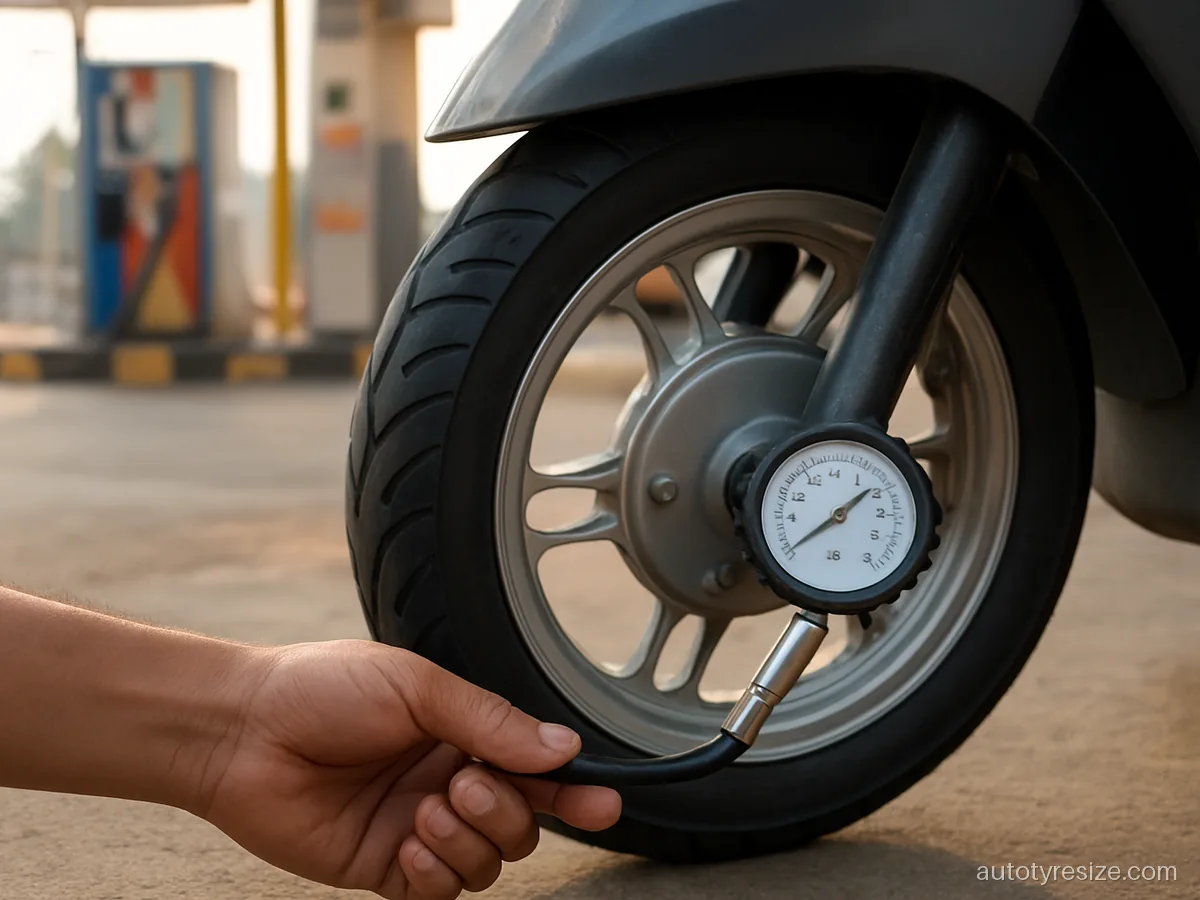
Activa 125 tyre pressure chart
Load never alters the front setting. Only the back changes, since that end carries the extra person.
| Load | Front | Rear |
|---|---|---|
| Rider only | 22 psi | 29 psi |
| Rider and pillion | 22 psi | 36 psi |
The same chart applies to the DLX, the H-Smart and the earlier drum and disc versions, since they all use 90/90-12 front and 90/100-10 rear tyres. One tyre guide suggests 34 psi at the rear for two-up use; the manual figure most sources quote is 36 psi.
Why 22 psi up front is not a mistake
Plenty of first time owners assume 22 psi is a typo and fill both ends to 30. The front of the Activa 125 carries much less weight than the back, where the engine, the swingarm unit and the seat sit. A lower figure keeps the front contact patch the right shape, so the scooter turns in cleanly and the front brake bites well.
Overfill the front and the handle feels twitchy over rough tar, the tyre skips on painted lane lines in the rain, and the crown of the tread smooths out long before the edges.
Checking pressure at a petrol pump
- Check before you ride far. After 3 or 4 km of stop and go riding, expect the gauge to show 2 or 3 psi extra.
- Rock the scooter onto its centre stand, then nudge the wheel round until the valve faces you near the bottom.
- Ask the attendant for 22 front and 29 rear, or 36 rear if you carry a pillion.
- Pump gauges vary. Keep a pocket gauge and recheck once a month.
- Put both valve caps back; a cap missing for months is a common reason for a creeping leak.
With only a warm reading available, never let air out just to match the book. Add what is missing, then recheck after the scooter has stood overnight. The reason is covered in how to check tyre pressure.
psi, bar and kPa for this scooter
Some air machines at fuel stations display bar or kPa. Here are the Activa 125 settings in those units, which match the kPa values Honda prints.
| psi | bar | kPa |
|---|---|---|
| 22 | 1.5 | 150 |
| 29 | 2.0 | 200 |
| 36 | 2.5 | 250 |
Odd readings on a digital pump can be checked with our tyre pressure converter.
Soft or hard tyres: effects on an Activa 125
Too little air is the common one. The 10 inch rear holds only a little air, so a 5 psi drop flattens it noticeably. The scooter feels heavy, mileage falls, the tyre runs hot, and a sharp pothole lip can squash the casing onto the rim and damage it.
Excess air sends every speed breaker straight up through the seat. It also shrinks the contact patch, so grip suffers on wet tar and on sand at the lane edge.
Rainy season, summer heat and weekend trips
During the monsoon, stick to the book figures rather than letting air out for comfort. Grooves only clear water well when the carcass is firm enough to hold them open. In peak summer, a parked scooter in the sun can read 2 psi high in the afternoon; check in the morning instead.
Planning a weekend ride two-up to a nearby hill town? Pump the rear to 36 psi at home, then confirm it at a fuel stop after the tyre has cooled. Shared tyre advice for all scooters is on the scooty tyre pressure page.
Questions owners ask
How much air for one person on an Activa 125?
Fill 22 psi in the front tyre and 29 psi in the rear tyre, checked cold. That is the owner's manual figure for one rider.
What changes when I carry a pillion?
Only the rear: take it to 36 psi, keep 22 psi in front, and drop the rear to 29 psi once you ride solo again.
Can I just run 30 psi at both ends?
Not really. That puts the front 8 psi over, which makes steering light and nervous. The rear would be close to the solo figure, so that end is fine for one rider.
Does nitrogen help on the Activa 125?
Nitrogen leaks a little slower, but the figures stay the same: 22 front and 29 rear. You still need to check it every two weeks. Ordinary air does the job fine if you keep it topped up.
How frequently should Activa 125 pressure be checked?
Every week or two, plus before a highway outing. A small scooter tyre loses pressure faster than a car tyre does.
Where does Honda list these figures?
Look in the owner's booklet that came with the scooter. Some models also have a label under the seat. Ignore the number on the tyre for filling; it only marks the limit.