
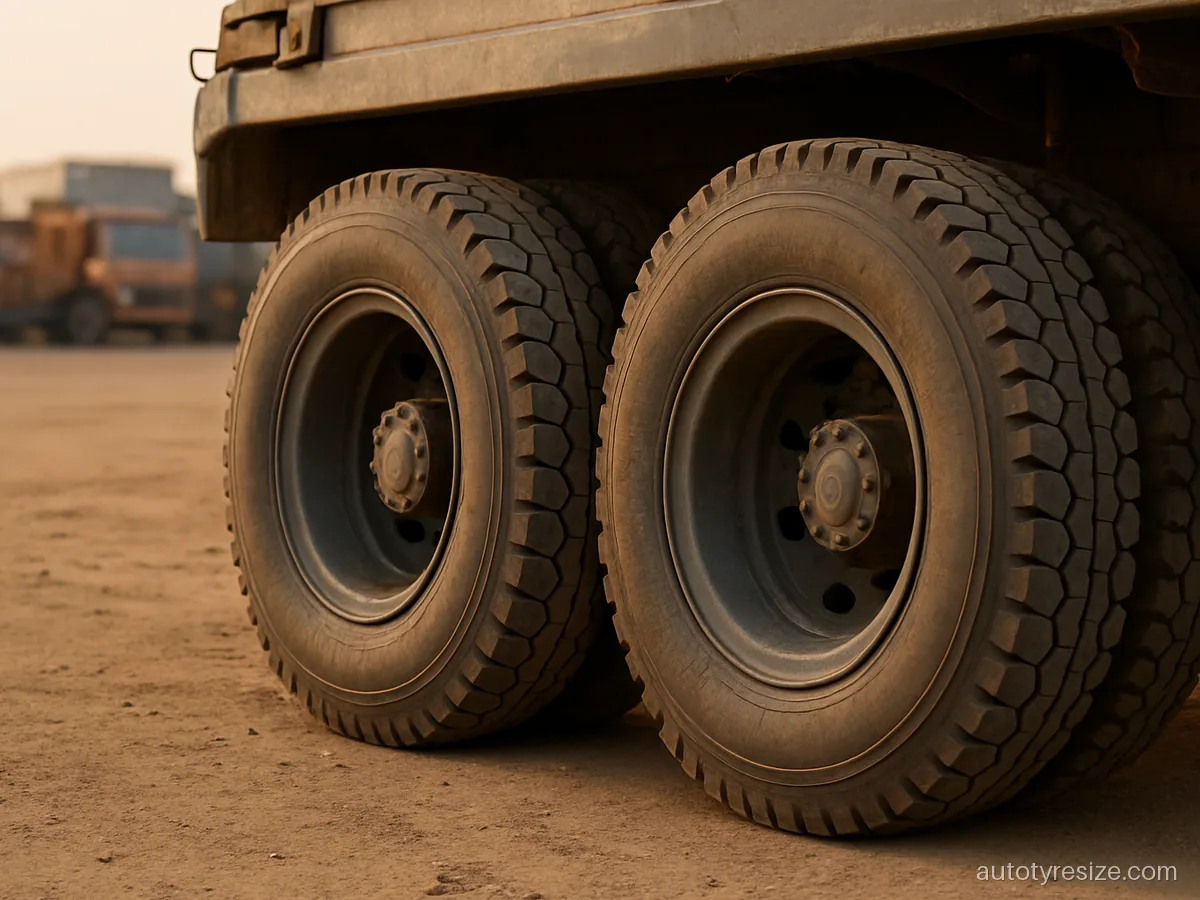
A truck tyre size is written either in inches, like 10.00-20 or 10.00 R20, or in metric form, like 295/80 R22.5, and the code on your current tyre sidewall is the one to match. Light goods vehicles, tippers, long haul trailers and city buses each use different sizes, so a size chart only helps once you know which vehicle and axle you are buying for.
Commercial tyres also carry a ply rating and a load index pair that car tyres do not. This guide explains each marking, the difference between bias and radial truck tyres, and what to check before mixing sizes on an axle. Smaller vehicles are covered from the car tyre size list.
At a glance
- Inch bias code10.00-20: about 10 inches wide, bias ply, 20 inch rim
- Inch radial code10.00 R20: same nominal size, radial construction
- Metric radial code295/80 R22.5: 295 mm wide, 80 percent profile, 22.5 inch rim
- Strength markingPly rating (PR) and a load index pair for single and dual fitment
- Where to checkSidewall of the fitted tyre, the RC and the maker's specification sheet
- PressureFar higher than car tyres; use the tyre maker's load and pressure table
Truck tire size chart: the three code styles
| Code style | Example | How to read it |
|---|---|---|
| Inch, bias | 10.00-20 | Nominal width about 10 inches, dash for bias ply, 20 inch rim |
| Inch, radial | 10.00 R20 | Same nominal width and rim, radial casing |
| Metric, radial | 295/80 R22.5 | 295 mm wide, sidewall 80 percent of width, 22.5 inch rim |
The examples show how each style is written. They are not a recommendation for your vehicle. The right size depends on the gross vehicle weight, the axle and the rim, all of which the vehicle maker sets.
Lorry tyre size: what the half inch rims mean
Rim sizes ending in .5, such as 17.5, 19.5 and 22.5, belong to tubeless truck tyres. These rims have a different bead seat shape from the whole number rims used with tubes and flaps, so a 22.5 inch tyre will never fit a 20 inch rim and a tube type tyre will not seal on a tubeless rim. If you want to move a fleet from tube type to tubeless, the wheels must change too.
Ply rating and the load index pair
Truck tyres carry two strength markings. The ply rating, shown as 16 PR, 18 PR and so on, rates casing strength. The service description often shows two load index numbers with a slash, then a speed letter. The first number is the load for the tyre fitted single, as on a steer axle. The second, lower number is the load for each tyre in a dual pair on a drive or trailer axle, where two tyres share the work. Never fit a tyre with lower ratings than the original. Overloading cooks the casing on long highway runs even when the tyre looks fine. Number by number, the load index page decodes them.
Bus tyre size and passenger loads
Buses use the same code styles as trucks. City buses that stop every few hundred metres need a tyre with strong sidewalls to handle kerb scuffing, while highway coaches need a casing that stays cool over long hours at speed. Steer tyres on any bus should always be in the best condition on the vehicle, because a front blowout on a loaded bus is the hardest failure to control. Fleet operators usually move partly worn steer tyres to the rear axles rather than run them to the limit at the front.
Bias or radial for Indian roads
Bias ply truck tyres have a tough sidewall that shrugs off rough loading yards and quarry roads, and they are easy to repair at a roadside shop. Radial truck tyres run cooler, roll more easily and usually give better mileage and fuel economy on highways. Never mix bias and radial tyres on the same axle, and on dual wheels both tyres in the pair must match in size, type and wear so they share the load evenly.
Truck tyre inflator and pressure checks
Truck tyres run at pressures far above car tyres, and the right figure depends on the load per tyre. Use the tyre maker's load and inflation table for your size, not a guess at the petrol pump. The small 12 volt inflators sold for cars cannot reach these pressures in reasonable time; fleets use workshop compressors or vehicle mounted air lines. If you carry a tyre inflator on a light truck, check that its maximum pressure is well above what your tyres need. Always check pressure cold, before the day's run. The tyre pressure guide covers the basics.
Dual wheel checks and when to replace
- Check the gap between dual tyres. Stones lodged between them can cut both sidewalls.
- Match tread depth in each dual pair so neither tyre carries more than its share.
- Replace any tyre with a bulge, a cut to the cords, separation at the tread edge or exposed steel belts. Get it examined by a tyre shop before another loaded trip.
- Retreads are common on drive and trailer axles; keep fresh casings on the steer axle.
For other heavy machines see the tractor tyre size and backhoe loader tyre size guides.
Questions owners ask
What does 10.00-20 mean on a truck tyre?
Ten inches is the nominal section width and twenty inches the wheel diameter; the hyphen marks a bias ply casing, while a 10.00 R20 is the radial version of the same nominal size.
What does 22.5 mean in a truck tyre size?
That figure is the rim's size, in inches. Half inch rim sizes like 22.5 are made for tubeless truck tyres and have a different bead seat from 20 inch tube type rims.
Can I fit a radial with a bias tyre on a truck?
Not on the same axle. Bias and radial tyres flex differently, so mixing them on one axle or in a dual pair causes uneven load sharing and handling problems.
How do I find the right lorry tyre size?
Read the size on the tyres now fitted, then confirm it in the vehicle maker's specification sheet for your model and axle. Match the ply rating and load index too.
Why do truck tyres show two load index numbers?
The first number is the load for a tyre fitted single. The second is for each tyre in a dual pair, which is a little lower because two tyres share the axle load.