
The Xpulse tyre size on the Hero Xpulse 200 4V is 90/90-21 up front and 120/80-18 behind, and both the Standard and Pro variants use the same pair. The tall 21 inch front wheel is what lets this bike roll over rocks, ruts and broken village roads that stop most commuters.
Hero lists the front as 90/90-21 54S and the rear as 120/80-18 62S, on spoked rims that take a tube. Below you will find what those numbers mean, how to shop for the 21 inch front, and what to know before you fit knobbies or a wider rear.
Xpulse 200 4V fitment card
- Front tyre
- 90/90-21 54S
- Rear tyre
- 120/80-18 62S
- Wheels
- 21 inch front, 18 inch rear, spoked, on every variant
- Tyre type
- Tube type
- Tyre pressure (cold)
- Front 25 psi, rear 33 psi solo; rear 36 psi with pillion
- Battery
- 12 volt, 6 Ah maintenance free
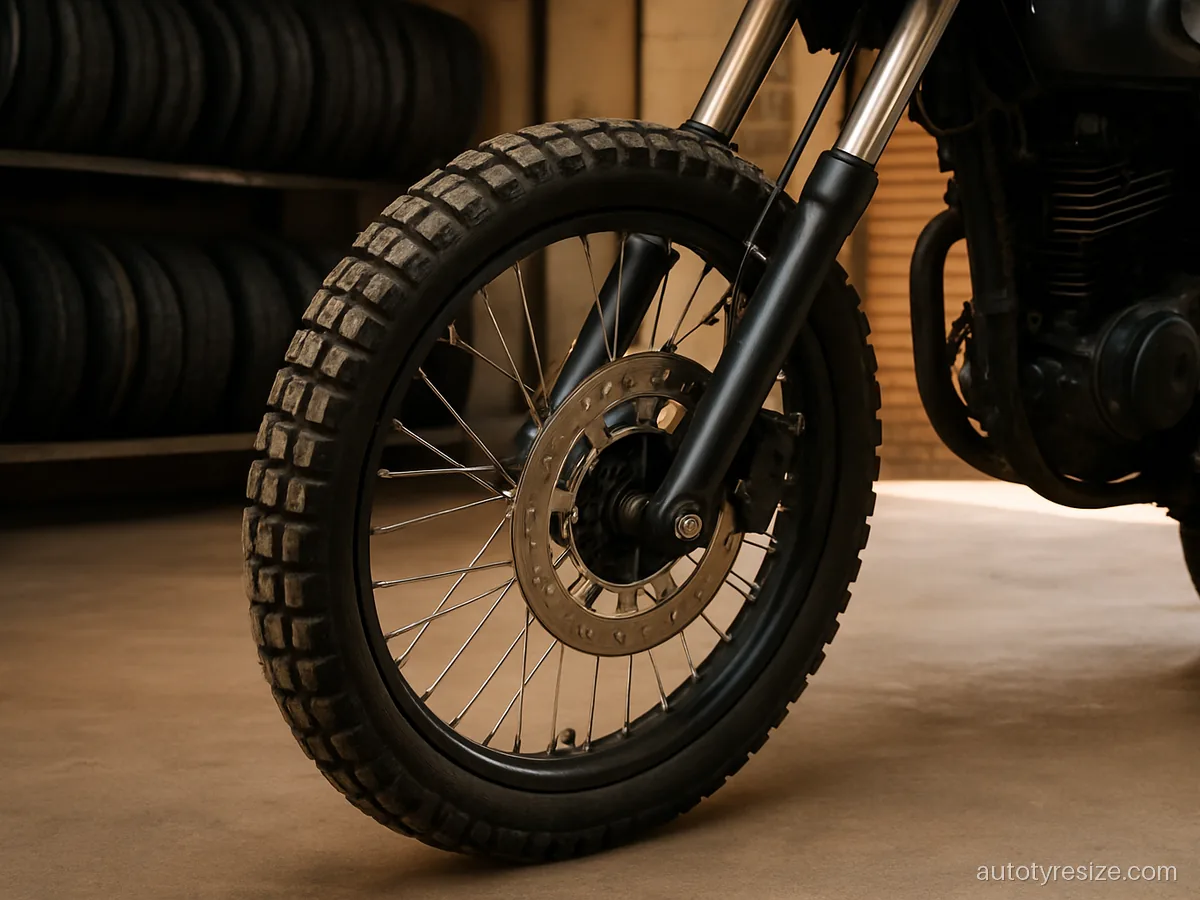
Xpulse tyre size by variant, front and rear
| Variant | Front | Rear | Wheel |
|---|---|---|---|
| Standard | 90/90-21 | 120/80-18 | 21 inch front, 18 inch rear, spoked |
| Pro | 90/90-21 | 120/80-18 | 21 inch front, 18 inch rear, spoked |
The Pro gets longer travel, adjustable suspension and a taller seat, but its wheels and rubber match the Standard. So if you searched for the xpulse 200 4v back tyre size or the front one, the answer does not change with the variant.
Reading 90/90-21 and 120/80-18 on the sidewall
On the front, 90 is the width in millimetres. Next comes 90 again, meaning an 81 mm wall on this narrow front. No R appears in this code, which signals cross ply (bias) build, and 21 names the rim in inches.
Decode the rear in the same order: 120 mm across, an 80 percent profile that gives a 96 mm wall, mounted on an 18 inch hoop. Those tall, soft walls are deliberate. They flex over stones and absorb the hits a dirt trail throws at the rim, which is why this bike shrugs off potholes better than a road bike with low profile radials.
Load index and speed letter: 54S and 62S
Hero prints 54S on the front tyre and 62S on the rear. Load index 54 means the front can carry 212 kg, and 62 means the rear can carry 265 kg at the right pressure. The letter S clears both tyres for 180 km/h, well beyond the top speed of this 200 cc single.
When you buy replacements, match or beat both numbers. A cheaper cover carrying a smaller load number can look identical yet run hot when two people and touring luggage sit on it all day.
Tube type tyres on spoked rims
Spoke wheels let air seep through the nipple holes, so the Xpulse runs tubes inside its tyres. So a thorn or nail normally drops the pressure within minutes instead of seeping out over days. On long rides pack two tyre levers, a small pump and a spare 21 inch tube, because roadside shops in small towns rarely stock that size.
Some owners convert to tubeless with sealed rim kits. It can work, but the sealing job must be done properly and checked often. Our tube vs tubeless comparison lays out both sides, and spoke vs alloy wheels explains why off road bikes keep spokes.
Upsizing the rear: the maths first
Stock, the front stands about 533.4 + 81 x 2, close to 695 mm tall. The rear works out to 457.2 + 96 x 2, roughly 649 mm. Some owners want a fatter 130/80-18 at the back. Its height is 457.2 + 104 x 2, near 665 mm, so it grows by about 2.5 percent.
The gain sits under the common 3 percent ceiling, yet Hero never fitted this size. Extra width can rub the chain, the swingarm or the chain guard, and a taller rear changes steering feel. Should you go ahead, get the fitter to mount the wheel and turn it slowly by hand while checking each gap. The front 21 inch size has very little choice, so stay with 90/90-21 up front.
Road, dual sport or knobby pattern
Hero ships the bike on a dual sport block that manages tarmac, gravel and dry dirt. Riders who mostly commute can pick a road biased block for longer life and better wet grip on city roads. Riders who spend weekends on muddy trails or in the hills during the monsoon often fit a knobby rear, which clears mud far better but wears quickly and hums on the highway.
Any pattern you choose should keep the stock size and a load and speed rating at least as high as 54S and 62S. Insist on recently made stock, and decode the week and batch with our tyre manufacturing date notes.
When to change the Xpulse tyres
Block tread wears unevenly. Rear knobs lose their square corners first, then begin to chip, mostly after long tarmac stretches. Swap the tyre once the wear indicators sit level with the knobs, when pieces of block are missing, or when fine cracks appear between the blocks. A cut or bulge in the sidewall from a sharp rock rules the tyre out; crawl to the nearest puncture or tyre shop and have the cut examined.
Also check the spokes while the wheel is off. A loose spoke rings flat when tapped and can let the rim go out of true. Our bike tyre life guide covers wear signs in more detail.
Questions owners ask
Which front tyre does the Xpulse 200 4V use?
Hero fits a 90/90-21 54S, on a 21 inch spoked rim. Both the Standard and Pro variants use it.
What is the Xpulse 200 back tyre size?
The back tyre is 120/80-18 with a 62S rating, on an 18 inch spoked rim. The same size is fitted on every variant of the 4V.
Are Xpulse tyres tubeless?
No. Air escapes past each spoke nipple on a wire wheel, so Hero fits tubes. Owners can seal the rim for tubeless use, though the job demands skill and periodic inspection.
Will a 130/80-18 back tyre suit the Xpulse 200?
Its height grows roughly 2.5 percent, so the speedo reading shifts very little. Because no factory bike wore it, the fitter should confirm the chain and swingarm have room first.
Is the Pro tyre size different from the Standard?
No. The Pro changes the suspension and seat height, but it keeps the same 90/90-21 front and 120/80-18 rear tyres.
How do I find the size on my own bike?
Read the sidewall of each tyre. The size comes first, followed by two digits and a letter, for example 90/90-21 54S.