
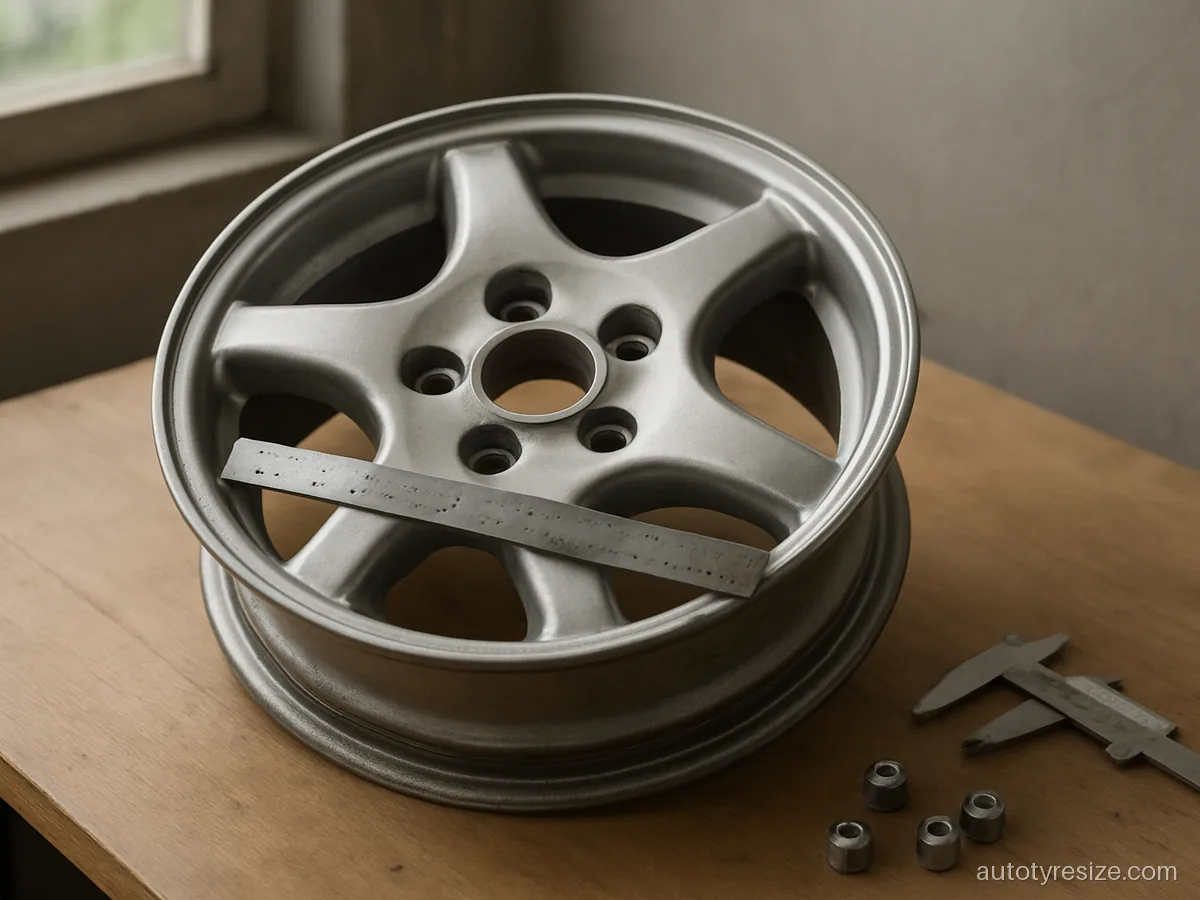
The PCD full form is pitch circle diameter: the size of an imaginary circle drawn through the centre of every bolt or stud hole on a wheel. It is written with the hole count first, so 4 x 100 mm means four holes spaced evenly on a circle 100 mm across.
At our counter, PCD is the first number we confirm before an alloy goes near a hub. A wheel can have the right diameter, the right width and a lovely finish, and still be useless if its holes sit on a circle a few millimetres off. Below we explain the term in plain words, show how to read it, and walk you through measuring it with a ruler.
At a glance
- Full formPitch circle diameter
- Written asHole count x circle size in mm, for example 4 x 100 mm or 5 x 114.3 mm
- Also calledBolt pattern or bolt circle
- Seen often in India4 x 100 mm on many small cars, 5 x 114.3 mm on many SUVs
- Measure on 4 holesCentre of one hole to centre of the opposite hole
- Measure on 5 holesNeighbouring hole centres x 1.7013
- Other meaningsPCD also stands for polycrystalline diamond in machining
PCD full form in mechanical and engineering drawings
In mechanical drawings, a pitch circle is the centre line on which a ring of holes is placed. Its diameter is the pitch circle diameter. Engineers use it for pipe flanges, pulleys, brake discs and wheel hubs, because one figure tells the machinist where every hole goes once the count is known.
So when people ask for the PCD full form in engineering or the PCD full form in manufacturing, the answer is the same: pitch circle diameter. That is the PCD meaning on a wheel too. The letters do mean other things in other trades. In machining, PCD also stands for polycrystalline diamond, a hard material used on cutting tool tips, and other industries use the same three letters for their own terms. On this site, and at any tyre or wheel shop, PCD means the bolt circle of the wheel.
How to read a PCD figure on a wheel
A wheel catalogue or the back of an alloy spoke may show the PCD in a few styles: 4 x 100, 4/100, 4x100 or PCD 100 with the hole count printed elsewhere. All of them say the same thing. The first number is how many holes the wheel has. The second is the circle size in millimetres.
Some figures look odd, such as 114.3. That one is simply 4.5 inches turned into millimetres (4.5 x 25.4 = 114.3), because the pattern started life in inch units. You may hear it called five by four and a half. The wheel does not care which name you use, only that the number matches your hub exactly.
| Marking | Holes | Circle size |
|---|---|---|
| 4 x 100 | 4 | 100 mm |
| 4 x 114.3 | 4 | 114.3 mm (4.5 inch) |
| 5 x 114.3 | 5 | 114.3 mm (4.5 inch) |
What is PCD in alloy wheels and why a near miss is dangerous
On a steel wheel from the factory, nobody thinks about PCD because the wheel was made for that hub. The question comes up with aftermarket alloys, a used set from a friend, or a spare borrowed from a different car. Patterns only a few millimetres apart do exist, and by eye they look identical.
If the circle is slightly wrong, the nuts can still be forced on. What happens next is the problem. Each stud gets pulled sideways, the tapered seats do not sit flat, and the wheel is held by bent studs instead of clamping force. We have seen such wheels loosen after a few weeks of potholes and speed breakers, wobble at highway speed, and crack studs. If a wheel only goes on with a push or a hammer tap, stop and check the PCD.
PCD figures you will meet on Indian cars
Motoring guides and wheel catalogues for the Indian market agree on two very common patterns. Many hatchbacks and compact sedans use 4 x 100 mm. Many compact and midsize SUVs and MPVs use 5 x 114.3 mm. Larger ladder frame SUVs and pickups often use other five and six hole patterns.
Treat this only as a starting point. Two cars from the same showroom can differ, and a new generation sometimes changes the pattern. For your own car, read the model page on our site, look in the owner's manual, or measure the hub as shown below. Our alloy wheels guide lists model pages for most popular cars and bikes.
How to measure PCD with a ruler or vernier
- Remove the wheel cover or centre cap so the studs or bolt holes are clear.
- Count the holes. The method depends on whether the count is even or odd.
- Four or six holes: measure from the centre of one hole straight across to the centre of the opposite hole. That distance is the PCD.
- Five holes: there is no opposite hole. Measure centre to centre between two neighbouring holes and multiply by 1.7013.
- Three holes (some small vehicles): neighbouring centres x 1.155.
- Round to the nearest standard pattern and confirm with the owner's manual or a wheel shop gauge.
A vernier caliper gives a cleaner reading than a tape. Finding exact centres by eye is hard, so read from the left side of one hole to the left side of the other, along the same straight line; the result is the same distance. Our PCD calculator does the multiplication for any hole count.
PCD is one of five checks, not the only one
A matching bolt circle gets the wheel onto the hub. Four other things decide whether it sits right:
- Centre bore: the big hole in the middle must be equal to or larger than the hub spigot. If it is larger, a hub centric ring fills the gap and stops vibration.
- Offset (ET): how far the mounting face sits from the wheel centre line, in mm. A lower ET pushes the wheel outward toward the fender.
- Width and diameter: these decide which tyre you can run and whether it rubs at full steering lock.
- Nut or bolt seat: alloys often need different nuts or bolts from steel wheels. Ask the wheel seller which ones the wheel needs.
Read more on sizes in our wheel size guide.
Our view on PCD adapters and wobble bolts
Adapters that convert one bolt circle to another, and wobble bolts with an off centre collar, are sold for people who want a wheel from a different pattern. We do not fit them on family cars. An adapter is also a spacer, so it pushes the wheel out and lowers the effective ET by its own thickness. That adds load on wheel bearings and can make the tyre rub. Every guide we trust says the same: buy a wheel made for your exact PCD. If a set you love is not made in your pattern, choose a different design.
Questions owners ask
Is PCD the same as bolt pattern?
Yes. PCD, bolt pattern and bolt circle all describe the number of holes and the size of the circle they sit on. A shop may say any of the three.
Does PCD change when I go from a 14 inch to a 16 inch wheel?
No. The PCD belongs to the hub, not the rim size. A bigger alloy for the same car must have the same PCD as the factory wheel.
What does PCD 4 x 100 mean in simple words?
Four bolt holes, with their centres on a circle 100 mm across. On a four hole wheel you can check it by measuring from one hole centre to the opposite hole centre.
Can a 4 x 98 or 4 x 10⁸ alloy fit a 4 x 100 hub?
Not safely. The nuts may go on, but the studs are pulled sideways and the wheel can loosen or crack studs. Buy a wheel in the exact pattern.
Is PCD measured in mm or inches?
Wheel catalogues in India use millimetres. Some patterns began in inches, which is why you see figures like 114.3 mm, equal to 4.5 inches.
What does PCD full form mean outside wheels?
In machining, PCD can mean polycrystalline diamond, a cutting tool material. Other trades use the letters for their own terms. For wheels and flanges, PCD is always pitch circle diameter.