
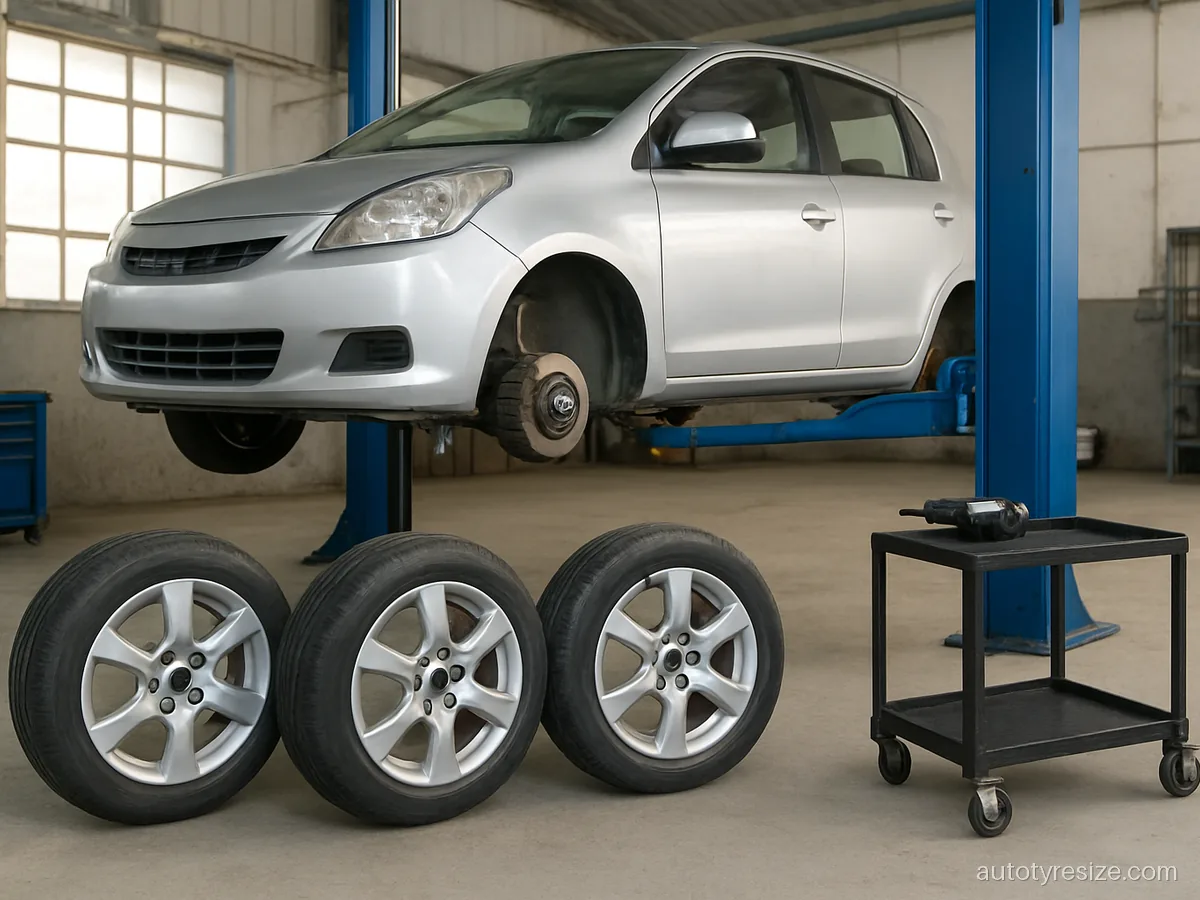
Tyre rotation means moving each tyre to a different corner of the car at set intervals, commonly around every 10,000 km or as the owner's manual says, so all four wear evenly and can be replaced together. The pattern depends on which wheels drive the car and on the type of tyre.
On a front wheel drive hatchback, the front tyres steer, brake hardest and put the power down. They can wear out well before the rears. Rotation shares that work. This guide gives the common patterns, how to include the spare, and what to check while the wheels are off. For more tyre care topics, see our home page.
At a glance
- WhyFront and rear tyres wear differently; swapping evens it out
- How oftenMany manuals and tyre makers say about every 10,000 km
- Front wheel driveFronts straight back, rears cross to the front
- Rear wheel and 4x4Rears straight forward, fronts cross to the back
- Directional tyresFront to back on the same side only
- Spare in rotationOnly a full size spare of the same tyre
Why tyre rotation matters on Indian roads
Each corner of a car works differently. Front tyres carry the engine weight on most cars, take most of the braking and scrub as they steer through tight city turns. On a front wheel drive car they also drive the car. Rear tyres mostly follow. Left tyres on Indian roads also tend to take more hits from the broken road edge and drain covers.
Without rotation you end up replacing two fronts long before the rears, and then the car has mismatched grip front to back. With rotation, all four wear at a similar rate. You also get a regular chance to look at every tyre closely.
Front wheel drive tyre rotation pattern
Most Indian hatchbacks, sedans and compact SUVs are front wheel drive. The usual pattern is called the forward cross:
| From | To |
|---|---|
| Front left | Rear left |
| Front right | Rear right |
| Rear left | Front right |
| Rear right | Front left |
In a tyre rotation diagram this looks like two straight arrows going back down each side and an X across the rear going forward. The worn front tyres go to the rear, where they work less, and the fresher rears move to the driving wheels.
Rear wheel drive and 4x4 rotation chart
For rear wheel drive and four wheel drive vehicles, such as many pickups, body on frame SUVs and larger MUVs, the pattern is the mirror image, called the rearward cross:
| From | To |
|---|---|
| Rear left | Front left |
| Rear right | Front right |
| Front left | Rear right |
| Front right | Rear left |
Rears move straight forward. Fronts cross to the opposite rear. Some owner's manuals use a simple X pattern instead, where every tyre crosses diagonally. Follow your manual if it shows a pattern.
Directional and asymmetric tyres
A directional tyre has an arrow on the sidewall showing which way it must roll. If you cross it to the other side, it rolls backwards and loses its water clearing ability. These tyres only swap front to back on the same side.
Asymmetric tyres are marked inside and outside. They can cross sides on most cars because the outside stays outside after remounting on the wheel, but some manuals still ask for front to back only. If your car has different sizes front and rear, which some performance cars do, the tyres can only swap side to side, if at all. Our tyre tread guide explains the pattern types.
5 tyre rotation chart with the spare
If your spare is a full size wheel with the same tyre as the other four, it can join the rotation. This spreads wear over five tyres and keeps the spare from ageing unused in the boot. A common 5 tyre rotation for a front wheel drive car:
| From | To |
|---|---|
| Spare | Rear right |
| Rear right | Front left |
| Rear left | Front right |
| Front left | Rear left |
| Front right | Spare |
Do not include a thin space saver spare or a spare on a different wheel size. Those are for short emergency use only. Our spare tyre guide explains the types. Whenever the spare comes into use, set its pressure to the normal running figure first.
7 tyre rotation chart for six wheel trucks
A light truck or pickup with dual rear wheels has six tyres on the road plus a spare. A 7 tyre rotation chart moves each tyre in turn through the front, outer rear and inner rear positions, and brings the spare into the cycle so all seven age together. Fleet owners usually follow the vehicle maker's chart or the tyre maker's fleet guide, since load and axle type vary a lot. Dual rear pairs must be matched closely in size and wear, or one tyre carries more load and heats up.
When to rotate and what to check
Many owner's manuals and tyre makers suggest rotating around every 10,000 km. Rotate earlier if you see the fronts wearing faster. A good habit is to rotate at every second service, or together with wheel balancing, since the wheels come off for both.
- Mark each tyre with chalk for its old position before removing.
- Check tread depth on all of them and note it.
- Look for uneven wear, which points to alignment or pressure problems.
- Check for nails, cuts and sidewall bulges.
- Tighten the nuts crosswise, never round in a circle, to the torque figure the car maker gives.
- Reset pressures, because front and rear figures may differ on your car.
If your car has tyre pressure sensors, some need a relearn after rotation. The manual will say.
What rotation cannot fix
Rotation spreads normal wear. It does not cure a fault. If a tyre wears on one edge, moving it will just spread the damage around. Fix the cause first with wheel alignment and correct pressure, then rotate.
A tyre that comes off with cord showing, a sidewall lump or a cut should not go back on any corner. Replace it, and ask the technician to look over the other tyres too.
Questions owners ask
How often should I do tyre rotation?
Follow the owner's manual. Many manuals and tyre makers suggest around every 10,000 km. Rotate sooner if the front tyres are clearly wearing faster.
What is the tyre rotation pattern for front wheel drive cars?
Front tyres move straight back on the same side. Rear tyres cross to the opposite front. This is called the forward cross.
Can I rotate directional tyres side to side?
No. Directional tyres must keep rolling the way the arrow points. Move them front to back on the same side only.
Should the spare tyre be included in rotation?
Only if it is a full size spare with the same tyre and wheel size. Space saver spares should stay out of the rotation.
Do two wheeler tyres need rotation?
No. Bike and scooter front and rear tyres are usually different sizes and patterns, so they cannot swap. Replace each when it is worn.
Is alignment needed after tyre rotation?
Not usually. Rotation does not change the wheel angles. But if you saw uneven wear when the tyres came off, get an alignment check.